Specialty Tape
Polyimide Tape for Solder Masking: Temperature, Width and Residue
Polyimide tape survives solder heat, but temperature is only one variable. Cover film thickness, silicone residue, die-cut widths and the effect of multiple reflow passes.
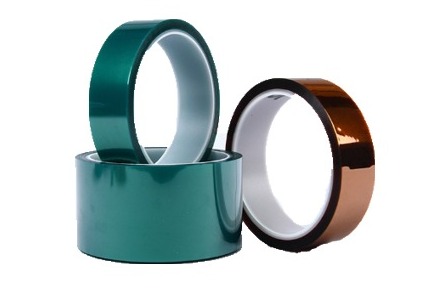
Polyimide tape is the standard answer for masking during soldering, and it is chosen mainly for one reason: it survives heat that destroys ordinary film. But temperature is only the first of three variables, and the other two, width and residue, cause the failures that actually reach a quality report.
This is a tape that works when it is matched to the process, and fails quietly when it is bought on temperature alone.
Surviving wave solder and reflow
Wave soldering and reflow expose tape to a thermal profile, not a single temperature. The board passes through preheat, a spike, and cooling. A polyimide film tolerates the spike, but the adhesive and the bond see the whole profile. What matters is not just the peak but how long the tape sits at elevated temperature and how many times it repeats the cycle.
A tape chosen for its peak rating but weak in repeated short cycles can fail on a second or third pass. Ask about the full profile, not the maximum figure.
Film thickness: 25 to 60 micron
Polyimide film is supplied from roughly 25 micron to 60 micron. Thin film conforms to fine features and tight keep-out areas, holds a low profile, and masks small pads precisely. Thicker film resists punctures and tears, holds its shape over connectors, and is easier to apply without wrinkles.
Match thickness to the feature. Fine-pitch masking and delicate gold fingers favour thinner film. Masking whole connectors or protecting a broad area through multiple passes favours thicker film, where tear resistance matters more than conformability.
Silicone adhesive and the residue problem
Polyimide tape almost always uses a silicone adhesive, because silicone retains its release properties across a wide temperature range. The trade-off is residue and contamination. Silicone can leave a film, and silicone contamination is a serious problem in electronics, where it can interfere with subsequent adhesion, conformal coating and wire bonding.
Silicone residue is the failure to watch, and it is often caused by thermal abuse rather than by the tape itself. Exceed the temperature envelope, leave the tape on through extra passes, or apply it to a hot surface, and the adhesive cross-links or transfers. Once that happens, removal is difficult and the contamination risk is high.
Remove the tape while it is still warm but not hot, and let it cool naturally before the next process. Pull it slowly and at a shallow angle.
Die-cut versus slit narrow widths
For narrow masking, tape can be slit from a standard log or die-cut to a precise shape. Slit tape is cheaper and fine for straight runs. Die-cut tape matches a specific footprint, such as a connector, a row of pads or a fine-pitch keep-out, and eliminates the placement error that hand-cutting introduces.
Where the geometry is repeated hundreds of times per board, die-cutting usually pays for itself in yield alone. It also removes the loose fibres and ragged edges that hand-trimmed tape leaves behind.
Gold fingers, connectors and multiple passes
Gold fingers and connector contacts demand a residue-free result, because any contamination shows up as a contact resistance fault later. Here the priorities are a clean-release silicone system, correct dwell, and removal before the adhesive bonds too firmly. Choose a film thin enough to conform without lifting, and avoid stretching it during application, which stores stress that later lifts an edge.
Boards that undergo multiple reflow passes stress the tape repeatedly. Each pass is a heat cycle that ages the adhesive a little. A tape that releases cleanly after one pass can transfer adhesive after three. Where multiple passes are expected, specify for the total exposure and trial the tape through the full number of cycles, not a single pass.
Insulation for transformers and winding
Polyimide tape also serves as a thin electrical insulation in transformer and motor winding, where its dielectric strength and heat resistance matter alongside its thin profile. In these applications the tape is not removed. It stays in the assembly, so clean-release properties recede and dielectric and thermal stability come to the front. Specify the film and adhesive for the class of insulation the design requires.
Browse the specialty tape range, read our notes on foil tape in HVAC systems, and request an FOB quote stating your soldering process, number of passes and the feature you are masking.